
Art on the Internet.

from the dark side of history
Guest Edited by Briony Hughes
with work from
Julia Biggs, Cat Chong, Francis de Lima, Matti Griso Dryer, Briony Hughes, Ed Jarrett, Lucy Lovell, Bethany Mitchell, VJ René, Robyn Skyrme, Elżbieta Wójcik-Leese, and Oliver Zarandi.
plus Chloë Proctor interviews JD Howse, an announcement from Permeable Barrier, and a call for submission of full-length manuscripts.

by Julia Biggs


The fragments of Graphology I – III were created by performing an erasure of G. Mackenzie Bacon’s ‘On the Writing of the Insane’ (1870), a treatise composed of psychiatric case studies and asylum patient narratives, in which handwriting is read as evidence of mind. This altered diagnostic text is paired with (and physically disrupted by) found, combined patient phrases in fragile scripts, uncovering a new set of compelling voices and visceral meanings.
Julia Biggs is a poet, writer and freelance art historian. She lives in Cambridge, UK. Her micro-chapbook ROLES was published by Ghost City Press in 2025, and her work has appeared in Osmosis Press, Ink Sweat & Tears, Streetcake Magazine, RIC Journal, Inkfish Magazine and elsewhere.
Julia can be found on Bluesky @chiaroscuro1897.bsky.social or via her website: https://juliabiggs1.wixsite.com/juliabiggs

from 'Death's Capital Sentence:
A Singaporean Lyric'
by Cat Chong
on any Friday morning at dawn
as the sun smashes into the equatorial earth
we speak out an island
where love and danger dwells in the membrane of wonder
judicial murder is scrawled into the sky
contract our vowels for in this world by mandate
is the administration of cannibal monstrosity
our displaced skin is this event
announcing the tenancy of our bodies
the state’s soul whip which pursues us
down to the molecular property ownership of the state
and in this drone we are gathered
and as the world trembles increasingly
and as the sun goes down flamboyantly
the law trembles its nooses
halt the air inside me
he shall be condemned
to suffer for the same the particular
underwritten in the scheme and scale
For Murder
To suffer death with confiscation
the body ignominiously exposed
By Amok . . . . . . as above directed; and, in
both cases property divided
and Piracy . . . . . . Death.
For Piracy
and enslaving of captives . . . . Death.
So from death I have borrowed my authority
from their logics of removal carceral protectionism
and sites of otherwise containment
as we state the pinnacle of collective organs
the law does menace the future. look behind the letters
to the fields of rust the size of our nations
which beside ourselves grant our starless inscrutable hours.
we were overtaken from above
mandated by formula and formulation
as delinquent bodies we were delivering our hearts to the coroner
of pain and peril
as love our memorial
moves reason beyond measure
calculation and all our names for such things
and so we the living
in this diffusion of terror
must know what we are doing
‘on any Friday morning at dawn’, ‘he shall be condemned’, and ‘So from death I have borrowed my authority’ are excerpted from their ongoing creative-critical work, titled ‘Death’s Capital Sentence: A Singaporean Lyric,’ which intervenes into Singapore’s adoption and continued use of the death penalty for non-violent drug offences. This work centres disability justice to outline the death penalty’s role within Singaporean civil society as an ableist and colonial tactic of state oppression; building on research undertaken within their PhD, this project combines archival and practice-based poetic strategies to trace the death penalty in Singapore from a tactic used to criminalise anti-colonial insurrection in the early 1800s to its contemporary usage deployed within its construction of the “war on drugs”.
Cat Chong is a poet, editor, and essayist who completed their PhD in medical humanities at Nanyang Technological University, Singapore, as a Nanyang President’s Graduate Scholar in 2024. Their most recent publications include 712 stanza homes for the sun (Broken Sleep Books, 2023), Dear Lettera 32 (Permeable Barrier, 2024), and When Health Becomes Available (Earthbound Press, 2026). They are the co-editor of Osmosis Press and an editorial assistant at Pamenar Press. Their first monograph Genrequeerness in Contemporary Experimental Life Writing: Gender, Genre, and Disability, is forthcoming from Bloomsbury Academic. They also work in Borough Market as a cheesemonger.
Cat can be found on Instagram @marbledmayhem

by Francis de Lima
In this loud silence the tabernacle of our lives etches a lion's face in the sand and asks us what else? You go to your work, and I go to mine and hold this pain like a skillet. You hold yours and I hold mine. Though crestfallen, we gesticulate wildly. Everything has its little dramas. How much a bought orchid meant, a dinner-invite, this manicured procession of trees that is the idea of the forest more than the forest itself - and what did we do here? Felt stupid in a good way, like we got the joke on the walk home? I circle London like a passage in a book with a red pen, a bog-standard paragraph. What are you built of? Bronze? Ages ago one of the professions of my people required you to become a human map, so you spread your skin over vast distances. Radiofrequencies of the noble-dead. If the sound of a decision is a high-C, mapped onto a scale, I've never been in tune with my body, but boy do I love the ocean. There is an animal at the end of time, limping. But then there's also the old immigrant woman with a crossword saying sit down. I'm trying to remember a word. It might be codicil. How do you hang a door? I could be an air traffic controller because I got good sight and bad equipment, and your dad was one which made me miss the temporary nature of the sky. But my keycard carries no permissions. Our lives were intertwined from the start, like the wobble of a step when a bag is half-empty instead of full, and you lift it with monumental force. We take the peaks with the throughs and build prophylactic monuments. Falcons nesting on top of the smokestacks at the sugar empire. When my name will hold weight, hold water, I can finally put something down. Collaged into the structure. Suspended in the word. And everything is X-ray, is the careful cutting out of a shape from a weave of cellulose. Narrative is knee-jerk, I aim to spread augury. Growing on me like moss, from lack of use, a riot of moisture and love, a biome onto itself. Am I a coward or a pragmatist? If it walks like a duck and talks like a duck it might be happiness, but never a duck. The ratchet of the old coin yard. The familiar smell. I never put much stake in the way of hope, the fool that I am.
Amendment is an unruly collage of a living incidental archive. It is built from phrases either heard, overheard, misheard, encountered, misunderstood, read, misread, looked up, or noted down during about a week, collaged together allowing meaning, maybe, to emerge.
Francis de Lima is a Finnish-Brazilian poet living in London, where they recently completed their MA in Poetic Practice at Royal Holloway. Many of their poems can be found in online literature magazines, and some have even been shortlisted for an award or two. They also work as a translator, as well as in various roles within independent theatre, film, and art projects, both in the UK and abroad.
Francis can be found on Instagram @francisborealis

by Matti Griso Dryer
Stub is a cross-genre hypertext narrative developed from research into Wikipedia. It is currently only available as a PDF, where readers are asked to navigate solely via hyperlink.
Matti Griso Dryer is a writer from North London who has recently made the big move to East London. They are completing an MA in Creative Writing from Queen Mary University of London, where they also organise literary events with Subtexts. More of their work can be found in Fruit Journal, TISSUE PAPERS, and Queerlings.
Matti can be found on instagram @mgd___mgd

by Briony Hughes
5.
from purity creased perpetually fused rippling fact
thin she raised her perpetually the wave paused and then drew out again
figurative
6.
nature description
7.
8.
it is past speeches am all fibre transported to diff. time
9.
what moves my heart, my legs?
let me be unseen now I will wrap
I am nowhere! Like a net of light; geraniums
10.
yellow
to comfort fractal vision I have eyes that look close to the ground and see insects
is anguish here
11.
andro? drowning I love and I hate
I love and I hate into each other with phrases words and words in phrases
meet into the moment * I love x we make an unsubstantial territory *
12.
sea who have never seen a human form waves are in solitude
creates a story
tread ground – water
13.
I
I will plant a lighthouse stability
waves pass & crash through books
14.
I hate dangling things; I hate dampish things
I could know everything in the world if I wished
15.
terror is meaning has gone
fracture outside the loop there are distinctions
time those are yellow words
16.
she has no body as the others have
this is time
17.
not a wool-gatherer
no windows to look
I was unable to lift my foot up the stair among the apple trees
18.
light distorts unintelligible obstacle
19.
sensitive of my spine I will assure myself, touching the rail, of something hard. Now I cannot sink; cannot altogether fall through the thin sheet now
I come now no edges no expansion of construction I am covered in warm flesh
yet resolute my cold body is warmed *
20.
21.
sharpened the edges I must make phrases and phrases must go on waving make phrases and phrases and so
22.
a game for the intellectual hubbub exactitude of hexameters obscure or formless
fears about other halls appointed repetition of
23.
all here is false
they are now separated
24.
re: the point I have no face we put off our distinctions as we enter
but here I am nobody. I have no face
we are all
25.
my continuity no sudden kisses
different
26.
lake of my mind could I be ‘they’
remote from all of this I be ‘they’ I would choose it;
soon distracted ‘they’
27.
the clouds the beast stamping a dangling wire, loose
X
everyone is a story
28.
to fix the moment X in reality blows neck of nape in gardens
intensely
witnesses shall walk
29.
have I run up these stars, in the dismal days of winter is waves
screw it tight into a ball Jinny dances
revenge on / in time and orderly, with gongs, with lessons
30. I am alive BUT I cannot follow any thought from
I move I dance - that face is my face
follow any thought from past to present
31.
myself only to names and faces
face. other people have faces watching me
not solid! Their world is the real world I must push my foot
32.
transparency of the body
there are some trees I like unreality
33.
the tide sinks
spine is soft like wax contact
is rippling; all is dancing
34.
I shall be a clinger to the outsides of worlds
35.
mark. w? intro? Tenderness at breakfast
he is always too late let out those linked phrases
physical live v. treat one thing to another
36.
37.
I blurred edges
with blurred edges too vegetable, too vapid
mathematics
38.
transcend – and inhabit space
I will knock. I will enter hours of order and discipline rejects time
suffering I will do it. I will knock. I will unfurl
39.
be a bruised day, an imperfect day
gong roar stir begin
40.
yes – they are all parts of the same continuum ego esp.
pirouetting and one man will single me out before I can put out the light
one man will single me out, some peculiar thing
attached to one person
41.
to whom shall I give all that now flows through me, from my warm, my porous body?
R – always reams of thin dream oh! to whom? oh! to whom? oh! to whom?
oh! to whom? there is some porous body oh!
42.
unity stands time flux waves stamp and stamp shall not meet here again
this is the final ceremony
43.
we disperse; the bee
the bee distracts us
into other lives
44.
but the day is still rolled up
some whispered words alone rolled up
men in these fields are doing real things
45.
images of speed
look at all glass from side by side my body lives a life of its own awakening sexuality
46.
word hoard – myself back into my body
is beginning humiliation we are nothing, I said, and fell
colour association is beginning
47.
part of the emerging monster to whom we are attached.”
this is part of the emerging monster to whom we are attached.”
this is part of the emerging monster to whom we are attached.”
48.
body passes I should be garden sounds when
form in forehead’ meeting-place of past and present
another spoke of meeting-place of passer-by
49.
waters of andro we are one).
do not believe in separation wreathe off my lips
stamps and stamps on the shore.”
50.
the fact is that I have little aptitude for reflection
we have not gauged of the story
masc a good phrase but it does matter next phase
51.
let me at least be honest those university women
not compromise. I am not timid
52.
then linked to human life – rhythm X
grasping tightly all that I possess
* what?
53.
54.
with colours
flowers decayed dead contact with death
unburied
55.
andro andro
in private, is secretive effect different transitions you, my self,
or none of them! but complex and many joined to my own biographer you understand
detached observer
56.
sexuality then a question mark (I have a phrase for that
all engaged, involved, drawn in longer case?
texture! harmful hurtful
57.
rhythm is the main thing in writing
peters out enough to carry me over the transition
women’s place (which is true) * *
58.
imaginings the real novelist many selves integrate, as I do. which of these people am I?
I need the stimulus of other people myself, merely
writer? comp?
59.
rise and fall and rise again
and I, for one instant, steeped in pleasure homoerotic young men
why discriminate? long name I feel it all I am inspired
60.
what did I write last night if it was not poetry? mixed up, become part of another
name and count make me what I am
grains that make me what I am how curiously even at a distance who am I?
61.
and flow of language, unexpected as it is as I talk, images “let me then create you you do not fog yourself with sense and then create you
62.
women only or was it snob intimacy = knowledge
63.
impersonate addict oneself
that is you; then I shall drop you I am trying to expose a secret told to nobody yet;
I do not impersonate I love?
64.
like a long wave X to be contracted by another *
I a poet? my dying day I am this that and the other
for I am
65.
more selves could wear that permanence
all changes. the arch of the willows in the manner of whomever
yet love is measure him what him
66.
“that means something. but what?
a contrast does not feel our total will be known; I am not
so he sits in an office
67.
I am conscious of flux, of disorder
like the rest perpetually torn and distressed by their disorder of flux
I am conscious of flux, of disorder; of annihilation and despair
68.
I watch it expand, contract; external
waves of the ordinary role of exaction yes; aimless
69.
see ending
my roots go down now I sleep, now I wake *
Faulty Copy can be understood as a rewriting, refiguring, or translation of Virginia Woolf's The Waves via annotations, underlining, and vandalism found across three copies of the text. Specifically, I sought out copies that had entered the collections of Royal Holloway's Founder's Reading Room and Bedford College's Tate Library from the period when each was an all-women's institution prior to becoming coeducational.
Briony Hughes is a poet, researcher, and lecturer at Royal Holloway, University of London, where she leads the Poetry Pathway for the MA in Creative Writing. She was the 2023-2024 Poet in Residence at the University of Surrey. She has published seven books of poetry including 'Speculative Frequencies' (Permeable Barrier, 2025), 'June: A Haunting' (Intergraphia, 2024) and 'Rhizomes' (Broken Sleep Books, 2023). Her monograph, 'Hydropoetics: Methodology, Material, and Practice for Ecofeminist Poetry' is forthcoming from Bloomsbury. Her poetic artists' books have been collected by various institutions including the National Poetry Library, The British Library, Senate House Library, Oxford's Bodleian Library, and Kings College London Special Collections. She co-edits Resurgence and Ecologist Magazine’s Poetry Feature and is Editor in Chief at Osmosis Press. She is currently investigating the impact of poetry in conservation practice through collaborations with the Bat Conservation Trust, Royal Parks, Richmond Arts Service, BBO Wildlife Trust, and Cambridge Botanic Garden, alongside Royal Holloway's Centre for Ecology, Evolution, and Behaviour.
Briony can be found on instagram @brihughespoet

Disappear
The earth is being turned upside down. The diggers heads hovering at grass level, and the
hedgerows are not yet grown but piles of mud form dirt chapels in that domed European
Style.
Badgers, dormice and thrushes are being consulted in accordance with the relevant
Policies.
‘But a humanitarian corridor would imply death outside of this’
‘Oh yes’
Diggers hats tipped on shovel handles. The pocket bibles annotated with dirt, the pocket
priests are whispering terrible things about you, but terrible things in the vernacular at
Least.
Abiezer Coppe is hunkered down behind a fence, gnashing his teeth at the streets.
Delicious worms are being offered, to sweeten the deal, and in line with appropriate
resource allocation outlined in appendix b.
*
Reappear
Anabaptists at the swimming pool.
Henry Denne preaches from the diving board: ‘let us set the head where the foot be, and
the foot the head’. A near flawless entry.
Muntzer watches out of one corner of one eye. He is petting a nun in the corner of the
pool, but whether this would constitute ‘heavy petting’ is a matter to be decided. Nobody
objects so far.
The Quaker’s and the Mennonite’s have a race. The Ranters are in the shallow end, and
are not what you could feasibly consider ‘sober’.
James Nayler is wearing his Jesus costume and has liberated a donkey, he bravely
attempts to ride it into the pool. The donkey bucks him into the slow lane.
Bloodied palm leaves are being skimmed off the waters surface by the diligent attendant.
*
Disappear again
And then they ran away like arch villains.
It is the simplest thing in the world to repent and not mean it. The popularity of the
approach is limited however. The creation of a flowchart to provide guidance in these
scenarios is in discussion, and will be due for release by the restoration.
Overturn overturn overturn
Coppe again, hand stretched out now saying ‘deliver your purse sirrah or the rust of that
silver will eat your flesh like fire’.
Having all things in common is not an option. Have all things in common or else the plague
of god will rot and consume all that you have. Or else
Deliver deliver deliver
Historically speaking, you don’t have to be here if you don’t want to.
Disappear, reappear, and disappear again utilises the voices of European radicals during the reformation era, from Ranters, Diggers, Levellers and Anabaptists. This period of attempting to ‘turn the world upside down’ is fused with influences from underground rap artists whose faces were/are covered when performing.
Ed Jarrett is a prose poet in Brighton, his work has appeared in datableed, tentacular magazine, 87 Press’s The Hythe and through Jakob Kroon gallery.

from 'Cankerblossom'
by Lucy Lovell
Creature Lessons
My fetish is the rich being kind to me.
Imagine that, the seagulls screaming
at the bleak drooling sky & a rich man
nodding at you without reflecting the air.
It would ease the general dread of social
gatherings & dreamy neurotic responses
that have been snagging on floral seams.
Maybe it would help sleep visit me again.
Maybe it would be a better world, where
there’s a reason for the corpses & the fact
that silk-looking dogs follow me around
with shame-tipped ears & join the gullsong.
I’d ask the dogs & gulls if the rich smiled
at them & they’d shake vibrantly, no no no.
Say, their kindness is currency like any other
& we refuse it. I’ve learnt from dogs & gulls.
Stationary Knife
How many days is this now?
A stag steps out into the road,
flared & flexing with their heart
fixed on the warm asphalt stretch.
Even if it is the evening & quiet,
he lingers out. Never made peace
& full of carnation, he’s fraught.
Pointed at the heart of things.
Cankerblossom is a poetic project that is attentive to a fraught, exhausted, and loving world.
Lucy Lovell is the editor of Fathomsun Press. Her poems have appeared in Blackbox Manifold, Pamenar Press, LUDD GANG, and other publications. They are the author of Each Sharper Complication (legitimate snack, 2020), In the Debt of Love (And False Fire, 2021), and God Bless All Petty Thieves (Chaff, 2025).
Lucy can be found on instagram @thelittlefoxes

Procedure easily succumbs
to misinterpretation
by Bethany Mitchell
Procedure easily succumbs to misinterpretation
Fallen in the wind or felled before the nesting season (they will not say), I am too dense, too heavy to be moved. Instead, I am abandoned atop my chipped and dusty kin.
My core is warm, glowing amber in the sun. But my rough bark is swooning water, frozen mid-ripple. I think of myself as an elephant’s leg, strong, with gnarled grey skin. Immoveable body but poached for vanity’s sake.
Where my dry skin has cracked, I display my pale-hay flesh, flecked with rose, mint, and yellow-green lichen. Elsewhere, are muddy-browns and pleurococchus-greens deep in my worn crevices.
I possess more swirls than neat rings, diaphanous dancer that I long to be, with mushroom-curves and fire-flickering curls. Inside my tie-die patterns, my sap-sweet scent is bonfire-warm and chrism-spiced.
I have no roots. I am just golden muscle, a mirrored geode, kaleidoscope of earth tones. My limbs are snapped into jagged tusks. This is no neat table setting on my back, but crass craters on a map, brackets around rust and cinder toffee.
Attempting to describe or understand an object, according to Richard Stamelman in his 1978 essay on ‘The Object in Poetry and Painting: Ponge and Picasso’, is: ‘like a person struggling to uproot a tree stump; he grabs hold of it at different places and pulls it in different directions, trying to unearth the buried parts.’ It’s an enchanting image, but I couldn’t help but wonder what had happened to the tree, for it to be no more than a stump? Would the tree – the log – understand the procedure by which it had fallen? What would it think of itself in that state? What would it tell us about the wood in which it was felled? What of its history? What would it tell us with the annals of its rings, its knots and striations? In order to greater appreciate and co-exist with the being at the centre of my questions, I imagined its inner life and strove to dissever the subject from the human values attached to it. What appeared was an almost-riddle, posing yet another question: how differently might humans live and act and exist, if more-than-human voices were lifted above the racket of our own?
Bethany Mitchell is a poet and writer whose work is experimental, ecological, and site-specific. Her poetry inspects local landscapes and interactions within them, and seeks to destabilise hierarchies of human/non-human. Bethany’s debut pamphlet, Shingle, was published by Broken Sleep Books in 2023. Her work has most recently appeared in Blow up Britain; Osmosis press’s featured writing; and Visual Verse.
Bethany can be found on Instagram @bethjmitch.

Three Poems
by Vj René
FACSIMILE OF LATOUCHE
This copy of the 1829 edition is
In excellent shape with only minor creasing.
The subject governs multiple nouns.
I
Is not “before I” in any material sense, but
Moves around, accumulating tendency. Nonetheless,
The term “hermaphrodite” remains applicable.
The edges may be marked where previously shelved.
June took us aback, carsick with givenness
(The presence of fragaria vesca and other
Taxonomies with which the reader may be familiar)
Contingencies that I have with you lately gone around.
Phillippe/Camille are/not the “same person”.
The afternoon swings on its tender, foreseeable hinge.
We find ourselves foxed by sudden tints of thisness, points
Of connexion which may be dis/continuous, for instance
Lovely weather we’re.
Strawberries, how thoughtful.
The subject “is”, without reregistration.
The book will be clean without any major markings, tho
It may be somewhat damp from previous use.
THESE BLUE CURTAINS
Quiver so enticingly in the temperate absence
Of projected authorial intent.
This is a not “a gun”.
It is “a picture of a gun”, hanging from the living room wall.
The aesthetic properties of the curtains, their
Lavender hue, do not necessarily resemble
“Our protagonist”, or the fact of her losing
The will to live.
Our protagonist in fact, is quite content
Has an extensive network of conspecifics
A robust constitution.
These are affective specificities, papered in Morris print.
This blue colour and that one stand in the internal
Relation of lighter and darker. Just as
This word is part of “your body”. (And this one. And this.)
It is nice to step outside a frame so densely populated
By inference. For instance
The slasher antagonist can at last
Reliniquish his obligations to phallocentrism
In favour of just “stabbing the little cunt”.
This violence is notational, unrelated to our protagonist
Who is, as has been established, securely attached
And stably employed. She has not
Shot herself with the image of the gun
Hanging from the “living room” wall.
All over the Morris print.
Though if she had
It would have been an act devoid of metaphor.
The curtains are allegedly blue.
SONNET ON THEME BY STOKER
I dislike conventional forms. I am exceptional.
I have a woman’s eye. It lingers stickily
Over the body’s reach and density, its syntax of hair.
I was only coincidentally desperate.
I struggle, but I do not struggle much.
For a minute I felt like a seaside town and spent
The next year accountable. I’d be interested
To see what it would mean to be ‘in company’, each day
Opening into the next, unguarded in address.
I have read your poems with my door locked
Late at night, surrounded by realities.
They touch me. How sweet it is.
I’m afraid this is a very sloppy letter.
I do not know how you will take it.
Informed by the fin de siècle transition of victorian literature into modernism, these three poems explore the way we related to language, gender, and the act of reading itself.
VJ René is the author of two pamphlets of poetry, Scavengers (Salo Press, 2021) and HYDRA (Marble Poetry, 2020). Recent critical and creative works appear in Victorian Popular Fictions Journal, Forum Journal and the Australasian Journal of Victorian Studies.
They can be found on instagram @byvjrene

'These I Have Known'
by Robyn Skyrme
The Boys
The Sussex Beacon is a charity which helps those living with HIV. In 2018 I was looking in the Sussex Beacon’s charity shop (on London Road, in Brighton) when I found a sturdy hardback in the gay bit.
The Boys, by Christopher Fitz-Simon, is a history — “a double biography” — of Irish actors and theatre entrepreneurs Micheál Mac Liammóir (1899–1978) and Hilton Edwards (1903–1982), who together founded The Gate Theatre in Dublin in 1928. As well as being significant figures in the history of Irish theatre, they were an acknowledged gay couple in hostile times. Éibhear Walshe called them “Ireland’s only visible gay couple”.
Just the previous week, my boyfriend and I had watched The Trial of Oscar Wilde, a Granada TV production of 1960 starring Mac Liammóir as Wilde. We hadn’t noticed the name and didn’t make the connection until much later. There is much which is fascinating about Mac Liammóir, and about Edwards, both of whom exaggerated aspects of their lives to seem more Irish — in particular, Mac Liammóir, whose birth name was Alfred Lee Willmore.
At the time, I had not even heard of either of these men. They were new names to me. What grabbed me — the reason I bought the book immediately — was its marginalia. The inner cover, the frontispiece, the contents page, the back pages, were absolutely covered in writing. I hollered my boyfriend over, convinced I had found treasure, and we asked the lovely man at the till to hold the book for us while we dashed back home up Hanover hill to get cash enough to buy it. Which, on our return, we did.
It was a sunny day. A beautiful man in the Open Market bakery sold us our lunch, and we sat down on the grass of The Level to see just what we’d got hold of. Starting on the inside front cover of The Boys, and across about fifteen of the following pages, all available white space was covered in a long list — a glittering roster of names from another era.
The handwriting was often unsteady. We assumed an old, frail hand. Mostly black ink, sometimes blue. The list bore several subtitles (places, dates) but the overall title of these graffiti seemed to be ‘These I Have Known’.
In the index of The Boys the entry ‘Brock, Patrick’ (indicating a single mention on page 86) was marked with an asterisk. The appearance of this name in the acknowledgments was marked likewise, and so was its one appearance in the text of the book. In the inside back cover there is a list of places, beginning in the UK and then going global, of which seven were underlined: Paris, Cairo, Petra, The Bridge, New York, Empire State, Statue Of Liberty. Suddenly, from Cairo onward, these lists of places were uniformly in capital letters — all except for the letter ‘i’, lowercase wherever it appeared.
Playing Egosmith
Patrick Brock was an Irish actor, strongly involved with the Gate Theatre from the 1930s onwards. In 2018 the only writing we could find about him was an obituary by David Godolphin, who seemed to have been a friend. This obituary told us that Brock’s last stage appearance had been in 1959 and his last TV appearance in 1983. His actor’s card was slipped inside The Boys. From the card (below) we learned Patrick Brock’s height, his chest, waist and inside leg measurements, his collar, suit size, shoe and glove size… and so on.
Yet it was very difficult to discover much else about him, anywhere. This copy of The Boys seemed a richer and stranger source than anything we could find.
The following summer I’d been commissioned to do an hour of something, anything, for an American arts radio station. My boyfriend and I decided to split the time into two half-hours of scripted spoken-word performance essays, and to dedicate one of them to a sketchy account of this figure, Patrick Brock, and of how this book had led us to him.
We discovered that Brock had written a column for the cinema magazine Classic Images, called ‘These I Have Known’, in which he recounted celebrity anecdotes. When this finished he wrote a similar column in Hollywood Studio Magazine, well into the 1990s, called ‘I Once Knew Them’. My boyfriend and I discovered that he had kept up long correspondences with certain stars including Gloria Swanson and Joan Crawford. We imagined that one day we would go to Dublin to find the archive which held those letters.
Patrick Brock, never much of a celebrity himself, seemed to enjoy being extremely close to some very famous people, moving in their circles. The list of names in The Boys, ‘These I Have Known’, which I began transcribing in the summer of 2019 but did not finish, ran across twenty-seven pages and included hundreds of people. These days there is a little more about him online, but still not much. He now has an IMDB page, and it looks like quite a few of his many small TV roles were uncredited.
On page 86 of The Boys, where Brock had asterisked a mention of his name, it was because he was cited attesting to the fact that James Mason and Micheál Mac Liammóir did not get on, during a 1936 production of Lady Precious Stream:
In 1992 the actor Patrick Brock, who joined the company for the same production and in whose home Mason stayed for a short time, said ‘the two men were not sympathetic’.
The Boys doesn’t actually mention that this production was in 1936. We know it was because Patrick Brock added the year in pen in the margin. He added a few annotations to the margins of this volume, but they were very sparse compared to the density of the lists of names he wrote in the front and back. To this remark from Betty Chancellor, when she was touring in Tangiers in 1936:
The stars, Hilton and Micheál, are being very grand, and staying at the Continental-Savoy!
Brock added:
I stayed here 1946
— and to a mention of the character [Horace] Egosmith, in Mary Manning’s Youth’s The Season (a character suggested to Manning by Samuel Beckett, we read somewhere), Brock added this annotation:
I played Egosmith in London in 1937
The character of Egosmith seems to have been well-cast, in this case: he is “a barman who never speaks, but listens to everyone”. It had begun to feel as if Brock had spent his days doing something similar — never really emerging, but standing in the wings and listening, to anything and everything. ‘These I Have Known’, this wonderful motley list, seemed like an index to a vast mental archive of overheard stories or anecdotes all witnessed from the periphery.
These marginal moments, in which Patrick Brock felt the need to add detail to what he read, were intriguing, and they became increasingly bittersweet as we looked more into them. Outside of The Boys, we found references to “a legend” in which Brock discovered the film star Peggy Cummins; indeed, that it was he who introduced her to The Gate Theatre. This report appeared many times, and never cited its source, so we couldn’t but wonder whether that source was Brock himself — especially when we noticed that this anecdote was never once printed without adding, afterwards, that Peggy Cummins herself had described it as “absolutely nonsense”. In time, it had become the case that this “legend”, Brock’s discovery of a film star, was a story only ever told so that it could immediately be rubbished by its subject.
Cecil Brock
Another of this curious man’s curious, glinting appearances in the life of a star is described in footnote 249 of Beyond Paradise: The Life of Ramon Novarro by Andre Soares:
In a 1991 article for the Hollywood Magazine, Patrick Brock states that in 1967 he found a critically ill Novarro at his London hotel room and rushed him to hospital. Brock also recounted having met Novarro several times during the actor’s trips to England [...]
But what if this too, in the words of Peggy Cummins, was “absolutely nonsense”? The footnote continues:
Yet, although Novarro wrote letters to a Cecil Brock in England, no correspondence or mention of Patrick Brock could be found in his personal documents. Additionally, there is no indication that Novarro visited England after 1960.
This is so glancing an oddness that Soares’s book doesn’t follow it up, which is perhaps fair enough. We did, though. According to Ramon Novarro’s letters, Cecil Brock seems to have had a more successful career than Patrick: stage (including roles at The Gate Theatre), film, and radio. In particular, in 1956/7, he appeared in Mrs Dale’s Diary for the BBC, notable for being the first significant radio serial, and for including an early example of a sympathetically represented gay man in broadcast drama (though this was not Cecil’s part; his was far more minor.)
There also turned up a tiny letter in Picturegoer magazine, in which Miss M. Cassidy, of Hampton, Middlesex, wrote, on November the 5th, 1955:
I should like to see that charming Irish actor Cecil Brock get better parts.
The parts he did get were, of course, Patrick’s too; ‘Cecil’ was a stage name, one which for some reason he had used while on intimate terms with Ramon Novarro. Or perhaps ‘Patrick’ was the stage name. Revisiting this now, in 2026, I read (online) that Brock’s birth name was Cecil Patrick Brock-Murphy, information of which there was no sign back in 2018/19 — but this is from an apparently AI generated page which scraped its information from, among other things, an earlier version of what you are reading right now (from 2021). Back in 2018, what we did learn from David Godolphin’s obituary was that it may have been a little more complicated than just choosing stage names: Patrick would sometimes claim that Cecil Brock was his father.
Patrick and Cecil Brock died in April 1999 in Denville Hall, which is a North London retirement home for actors. We read that his memory and his flair for celebrity anecdotes persisted until the end, and he would delight fellow residents by remembering to them their own lives and careers in far more detail than they could themselves.
However it was that The Boys ended up in a Brighton charity shop — my own assumption is that it was the redistribution of a library, following the death of someone once close to Brock — it was a remarkable thing to find, and is something I’ve always intended to come back to, even without the book itself. This brief account will do, for now. There are some details I swear I remember but cannot seem to corroborate: I recall, for instance, my boyfriend telling me (with the final three words in block capitals) that Brock while working at The Gate Theatre lived with his mother and James Mason.
This boyfriend and I broke up in 2020, and we agreed that he’d keep The Boys. I did take scans of every single page on which Patrick had written, hence some of the detail and the images here. For all I know, he has a folder of Brock research somewhere too, whether active or gathering dust. He did the bulk of the research in 2019 and wrote the script for the radio. It was for that reason that we felt he was more likely to make a project of it, and we decided between us that he should keep the book. I slightly regret that we made the decision we did, but we made it.
I am unsure how to bring this sketch to a close, other than to leave you with Patrick Brock’s own words. This is the only other direct quotation which I still have. In 1958, Patrick [Cecil?] Brock worked with Errol Flynn. Twenty-seven years later, in a 1985 column of ‘I Once Knew Them’, Brock wrote of Flynn:
After his death I read his posthumous autobiography, and the later scandalous books picturing him as a spy or worse. But I only remember the sad and disintegrating and very likeable man.


In 'These I Have Known' a chance encounter with a book leads Robyn Skyrme to follow traces left behind by the obscure Irish actor Patrick Brock.
Robyn Skyrme is a writer. His half-hour radio script, paired with that mentioned above dedicated to Patrick Brock, was called ‘In Search of Theodore Garrigou’ and became ‘Chapter 80: Letters’ in the prose collection Candles and Water. Recent publications include In That Hoarding, That Drinking In The Sun (Fathomsun Press) and Shapeshifting (Weather Band). His first novel, Old Owl and Matt, is forthcoming from Book Works.

The Cloud Mending Project
(2020-2026)
by Elżbieta Wójcik-Leese


The Cloud Mending Project (2020-2026) started on July 27, 2023: I visited Copenhagen Contemporary to participate in Lee Mingwei’s The Mending Project. Instead of a piece of clothing, I handed the Mender the worn-out Cloud Classification I printed in the first lockdown and consulted ever since. While Cecilie was stitching the torn paper, we spoke about translation (she chatted with a person before me in German) and the opening sentence of Dickens’s Our Mutual Friend. As our conversation warmed up, Cecilie offered to use her own, ‘unofficial,’ white fluorescent thread. She stitched for me the word charge – indeed, under the cover of her jumper, it glowed. I donated the mended sheet to the project, but when I returned to collect it on September 7, 2023, the curating team could not find it. Left only with its digital image, I decided to re-create it materially as a visual poem. What intrigues me in Lee Mingwei’s participatory art is dialogue as repair, which relies on strangers’ gifts of trust. My procedural work gained its unexpected epilogue on October 7, 2025. I came to Moderna Museet Malmö to see Best regards, Lee Mingwei. I didn’t expect The Mending Project – but there it was. In a gesture that would mend the tear from two years ago, I tore two pages from my notebook and asked the Mender to stitch them back together. She suggested I chose multiple threads and used all five, commenting on her associations with sea and sky. When I revealed the history of this repair, she explained the stitch could symbolize the bridge across Øresund: Copenhagen and Malmö connected over the Sound. And the French knots might become clouds…
Elżbieta Wójcik-Leese writes with/in English, Polish and Danish. Her multilingual and environmental texts have appeared in various anthologies and journals, including Long Poem Magazine, Shearsman, Finished Creatures, Cordite Poetry Review, Poetry Salzburg Review and Tears in the Fence. Her artist’s book convers(at)ion: sea fog chalk was published by Essence Press in 2024 and preter/natural appetite for chalk, her visual poetry pamphlet, is out from intergraphia (2025). She co-curates and runs ‘Transreading’ courses on transnational and hybrid poetries for the Poetry School in London. Her site-specific verbal and visual texts use such analogue processes as botanical inkmaking, alternative photography, expressive handwriting and book art.
Elżbieta can be found on Instagram @elzbietawojcikleese

Bodies of Water
by Oliver Zarandi
It wasn’t a completely irrational fear—just a meter away, we had a towel cupboard. At the foot of the cupboard, some pipes ran down into the dark of this Georgian house, a house that was cleaved in two so two families could live there. My room was right above the divide, a literal sign of my indecision and fears and superstitions. But down in the bottom of that hole in our bathroom, there was a smell. It was where I’d throw my food away, as if I was feeding something down there. The food stained the wood. Sometimes I’d forget to clean it up—remove the evidence—and the food would go hard. I knew my mother knew about it. She sometimes called me out on it. But I still did it, kept putting the food in my mouth at dinner, pretending to cough and hiding it in my pockets. I’d excuse myself and run upstairs and feed the monster under my house. I can see it now, a skeletal figure like the ones in my history books, a body that you’d see on a mountain of other bodies, a body that you’d expect to see in a book of medical anomalies —analysed, forgotten, discarded — and it was pale, the eyes bloated and black like wet olives, its torso an empty plastic bag fizzing electrically as it breathed in and out. Feed me, it would say, and I did. It was never full.
I’d get into the bath and sink in slowly. I’d pull some bubbles to cover my genitals and then call for my mum to come in. She would shampoo my hair and massage my head. She would wash the water away and I'd cover my eyes completely because I thought shampoo could blind you. I waited for her to wash the shampoo out of my hair, then put my hands out to take the towel from her, wiping my eyes until all I saw were colors bruising my vision.
This was not just routine—it was ritual. I don’t think I even knew what the word ritual meant as a young boy, but there is something almost religious about that image of me, a young, ailing body, a body yellowed and browned and pale like a banana. I was afraid to wash my hair by myself. I told my mom about this memory and she told me that she was afraid people would think she was a weird mother. I was quick to remind her that this wasn’t the case. I was young and refused to wash myself, so she just gave me that push to do so. This wasn’t something that lasted throughout my teenage years, but was instead something earlier on. Apparently I smelled badly too.
There are parallels with here and the fact I was afraid to swallow solid food. Was this because my mother chewed my food as a child?
I think back to a time when I was perhaps 4 or 5 years old. I can’t quite remember what the situation is, but I’m sitting on the floor next to a chesterfield sofa and my mother is holding a plate of food in front of me. She twirls a fork around the spaghetti and then puts it in her mouth. She chews the food into mulch and then puts it back on the fork. She feeds it back to me. I eat what my mother has chewed.
According to my mom, I choked on a banana when I was 2 or 3 years old. I never knew about this until I was writing this book. Yes, she said, you choked and you were turning blue. I almost can’t believe I didn’t know about this, and maybe there’s some sort of memory of this choking in my throat, a part of me that remembers the feeling of that banana turning me blue. I decided to eat a banana shortly after my mom told me this and the banana felt thick inside my mouth. Take smaller bites, I told myself. I always tell myself this when I eat now. Don’t get greedy. Small bites and chew it methodically. This way nothing awful can happen. This way, I won’t choke and turn blue and die.
I’m searching Google for bathing or bodies of water in painting, film and literature. I start wondering why I’m so fixated on different liquids and fluids: blood, water, semen. Is this because I was so afraid of chewing and swallowing solid food? I don’t know. I see myself as a teenager again, my body like a bag of bones sitting in the bath water, my skin so pale. My mom washing my hair for me, massaging the shampoo into my scalp. Handing me the towel to dry my eyes off. I keep thinking of old fashioned words like invalid, my body as something helpless. I told my mom that I was looking into bathing and helpless, sick bodies. That’s ridiculous, she said. It wasn’t anything to do with that. And I get her reservations into how I paint this exploration. I am very conscious of how my parents come off here. But one thing to note is that I’m still asking my mom for permission. I shouldn’t. Let me explore this at my will, let me excavate myself the way I want to.
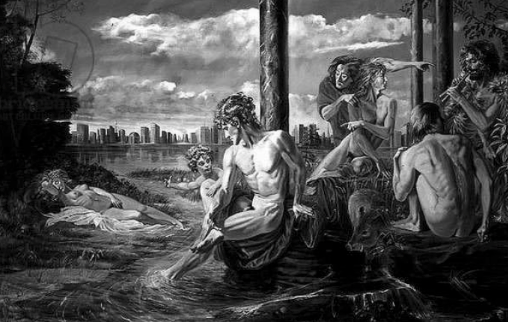
On Google: Woman in a Tub by Edgar Degas, Picasso’s Female Bather by the Sea. These are all women being painted by men, though. I was an ailing male body in that murky water and would frequently roll back my foreskin and clean the top of my penis, watching the dirt disappear into the water. Would Degas like to paint that? I felt frozen in time, like I was never going to grow up. The bathroom was a place where I was nearly allowed to be intimate with my body, but there was always the threat of my mom coming into the room. When I think of bathing now, or bodies of water, I think of sex or the threat of sex. I think of André Durand’s The Death of Adonis (1993), of those classical adult bodies stripped bare in the foreground, their muscles and sinews so graceful, and in the background a modern city of skyscrapers and pollution. I used to look at this painting when I was younger — I won an art book for my painting and would pore over these images, usually fixating on bodies in pieces: pectorals and arms, or collarbones, or ankles, the soles of feet, buttocks, genitals.
The Death of Adonis, Andre Durand (1993)
In hindsight, the sight of my body in the bathtub, my mom coming in to wash my hair, is completely infantilising. I felt as if I would never achieve the body from Durand’s painting. When I was in the school changing rooms, I wouldn’t dare shower with the other boys. I was ashamed of my body and would go to my next class dirty and stinking. Washing, I thought, was something I did at home, and something I needed my mom’s help for. I’d stare at the other boys’ bodies in the changing rooms, how their torsos had got thicker, or the bulge in their pants had got bigger. It was at this point that I felt more like a ‘freak’ than ever.
Water as cleansing, as baptismal: thoughts of Jesus, Christian baptisms, images of churches, of fonts, of holy water, of sacred wells and the forgotten water systems underneath the city of London, images that I can see projected onto my sticky eyeballs, lids pinned open ala A Clockwork Orange. Thoughts of people being washed or submerged in films and paintings: Bill Murray being baptized in Tim Burton’s Ed Wood (1994) comes to mind, reminding me of my fear of being submerged not just in water, but also a fear of letting go full stop, don’t touch me, I can’t breathe, give me some Space.
Ed Wood (1994)
John Steuart Curry’s Baptism in Kansas (1928): the color of the baptizer’s face stone-like, his legs strong, ready to submerge the young woman in a water tank.
John Steuart Curry, Baptism in Kansas (1928)
Henri-Georges Clouzot’s Les Diaboliques (1955): the supposedly drowned body of Michel (Paul Meurisse) emerging from the bathtub, eyes rolled back in his head. Water, then, as the site of betrayal, cruelty, humiliation.
Les Diaboliques (1955)
Water as a curative, something with healing powers to help the lame, the sick, the destroyed. I think of elongated pilgrim feet being gently washed in temples or bathhouses. I think of this from the point of view of the washer, their hands caressing the feet of the pilgrim, strange images of dog-like erections like tiny lipsticks squeezing out of somebody’s fleshy pubis.
The Princess Doria washing the feet of the Pilgrims, 1846, Sir David Wilkie
Water as a necessity: I think of washing my genitals after sex, peeling back my foreskin and seeing the blood or gunk of somebody else being washed from the contours of my penis. The Simpsons: Boy Scoutz in the Hood, Homer dying of thirst in the middle of the ocean giving this advice: “water water everywhere, so let’s all have a drink.” The washing of wounds and the washing of feet in Domenco Di Bartolo’s fresco from 1440. Terrence Malik’s The Thin Red Line: “We. We together. One being. Flow together like water. Till I can't tell you from me. I drink you. Now. Now.”
Domenico di Bartolo, Care of the Sick, 1441–1442
It always comes back to that, to the vulnerable body submerging itself in water, or being assisted by somebody else. Bathtubs and water as the site of vulnerability, then, a place of intimacy. I imagine myself to look like Solomon (Jacob Reynolds) in Gummo (1997): sickly and gross, a boy submerged in textures — the green bathwater, the blue tiled walls, his shampooed hair, his ribs sticking out, and a sloppy spaghetti meal placed upon a tray.
Gummo (1997)
When I think of myself in the bathroom or in the bathtub, I try to see things as if they were a film, and none of those films are directed by Harmony Korine. The hole in the towel cupboard where I spat my food yawns and groans like something from an Argento giallo, or, better yet, J. Michael Muro’s Street Trash (1987). The food stuck to the wood and the pipes and must’ve collected at the bottom like a sort of corpse. In the first few hours I imagine the food was moist and spongy down there in that pit, the guts of the bathroom, perhaps made even worse by the humidity of the warm bath that, when we ran the hot taps, steam would rise and curl its fingers up the walls. But after a few days, the food, I am sure, would become hard. Any soft edges that you could poke with your fingers in the first few hours have now rounded and hardened like a scab, not even pustules like the first few hours, pustules that I am sure if poked, would ooze by masticated lasagne sheet and chewed-up minced beef into the dusty underbelly of the Georgian house. Yes, the food would become hard in that very space where my hair was shampooed, where I would close my eyes as hard as I could, where I could not put my head under water for fear of drowning, where I would gently sponge my Gummo-style ribbed chest, or, in the murky water, I would roll back my foreskin — painful back in those days, as it was tighter — and rub away the dirt and see it float off into the water, goodbye goodbye. Perhaps the scene wouldn’t be directed by Muro at all, but would be left to a director like Terrence Malik, who may find some beauty in the vulnerability of that weak body in the bathtub, perhaps even going under the water and giving power to my body from that perspective. Perhaps this bath time at home was respite from everything else that was going on, as if we’d pressed pause on our life’s VHS controller: my mom would always be the caring mother, I would always be the helpless child. School was hell, as I compared myself to everybody around me and felt left behind. Home wasn’t perfect, but it was the framework I was perhaps most comfortable in, the place where I had at least some control and it was in the bathtub where I could settle into this comfortable role and let myself drift into the murky water and disappear, the dirt from my body floating away into the depths of the bath water.
My mom chewed my food for me when I was a child, like a bird. Premastication. Although I believe that my mother did this with the best intentions, I also believe that it had an adverse effect on me and that in the act of chewing for me, my mom had already done half the action, removing the need for my jaw to learn that movement.
And this was the same in the bath when I was younger, too. My mother had done it for me. I wasn’t a body with a mind of its own, there in the bath: I didn’t have to face reality. It was as if my body wasn’t trusted to act on its own, so these actions were acted upon me. I don’t trust my own body to perform the act of swallowing and have to think carefully every time I eat. I have to be aware of the different textures and negotiate with them inside my mouth. This feeling of inadequacy with my own body doesn’t just stop at my mouth and throat. Even looking at myself in the mirror as a teenager made me sick. Comparing myself to pornography actors and measuring my penis every day. Holding my skinny wrists and ankles, hoping they’d grow one day. My bony chest. Everything about me made me sick and when I masturbated, I would struggle to cum because I would think: why does this body deserve pleasure? It deserves to be destroyed.
The act of not swallowing, of not orgasming, of not being enough, ever, of wanting to be destroyed, beaten down, bullied, fucked, violated: these are all ideas of allowance and denial. I wonder if my eating disorder was an unconscious denial on my behalf? I spoke to my therapist yesterday about how I blamed myself for such a long time when it came to my eating, that I ruined my parents' lives. This narrative has shifted somewhat: it’s not about blame, but there are so many questions. Did I deny myself food to become more apparent to my parents? Did I crave attention so much that I enacted the paradox of disappearing to appear? Was this my magic trick? As traumatic as this was for my mom and dad, was this a way of keeping me forever as a child? Oliver, the birthday boy, the baby of the family, frozen in time. Would I always remain a child? A large teenage head screwed onto a small bony frame: skinny arms, small hands, small legs and feet, no muscle. I think of being bathed again, the ailing body, hairless and wet, being held aloft by disciples. I think of dead Jesus, those bony toes of renaissance paintings, the strange blue pallor of the dead. Was my eating disorder a cry for attention? Look at me. Was it a way of seizing control from my parents? Why does everything feel like a contradiction? To be seen and not seen. To get attention and to remain in the shadows. To be around people and to shrink from them completely.
It was like I was in conversation with every part of my body. My throat was the place where I felt most conscious of myself: every day I thought there was something growing inside my throat, this ball, and I’d go into the bathroom every day, open my mouth and try to look down into the depths of my throat, to see if there was anything in there. There wasn’t, but it felt like there was.
I’m still self conscious about my throat and still have problems swallowing food, so I try to eat with the smallest bites possible. When I was younger, the moment the food entered my mouth, I’d seize up and a ball would form inside my throat. The food tasted awful. I’d start chewing it and chewing it and chewing it until the food was just a formless sludge in my mouth. I just couldn’t do it. I remember my parents staring at me at dinner, that look of disappointment, worry, or perhaps both. But I didn’t actually know that. It’s amazing what fictions your brain will play out when you’re swamped by a nameless illness. Whatever was wrong with me, it was quiet, mute, but always with me. Instead of swallowing the food, I’d spit it up into my palm and put the food in my pockets. I’d take it to the toilet and flush it away, or hide it inside of jars, throw it out the window.
It still feels important to arrange the food on my plate in a way that is easy to digest with my eyes first. It’s harder to see progress when you’re eating from a bowl, so I mostly always choose a plate. It’s easier to strategically place the food to make it look like you’ve eaten more than you actually have. But as a teenager, I couldn’t even bring myself to swallow the food anyway, so I’d shovel the food into my mouth and play the role of a person who enjoys their food. I desperately wanted to be normal and enjoy food the same way others enjoyed food, making all those loathsome noises like mmm or yum, those clicking noises people’s mouths make on cookery shows, desperately wanted to be the same as my family at the table, or the other kids I went to school with who ate so naturally.
The movement of bringing my fork to my mouth and putting the food inside it was completely mechanical, a form of placation. I’d chew the food over and over again with my strange mechanical jaw until the food became a hairy mass inside my mouth. I would always hesitate to breathe too quickly here, just in case I swallowed a chunk of this hairy ball and choked to death. So I’d slow my breathing and pretend to cough, cough that food right into the palm of my hand. It’s so weird, I used to think, how food has one texture before and another one after.
Fish, for example, becomes a hairy mess in your mouth and feels like a small pet when you spit it back out into your palm. I’d pocket the ball of chewed up dish and go to the toilet and flush it down the toilet or, failing that, open the window by the toilet and discard it that way. I was terrible at hiding the evidence, however. My parents would routinely find spat out food in pots or down the sides of sofas or outside that toilet window. Their disappointment and anger upset me so much. I’d think: I am useless. I can’t even do what comes naturally to people. They didn’t understand what was wrong with me, and neither did I.
There seems to be something so important about bathrooms in my mind, about bathtubs and sinks and towel cupboards and wetness. I’m fixated on the idea of the bathroom being a place where I washed my body, but also discarded the very food that would sustain that body. It was also where the scales were kept. I’d weigh myself every day to see if I’d put on even the smallest amount of weight. I hovered around 6.5 to 7 stones in weight on average. I’d even try to lie to myself and wear heavier clothes when I got on those scales to manipulate the number. To this day I hate the sound of cheap scales as you place your feet on them. The scales were kept right next to the hole in the floorboards where I threw my food away.
As a child, seeing my dad shave his neck carefully: using shaving foam to coat that neck — which, even now, I still think of as the positive version of the throat, its negative alter-ego — and slowly scraping his stubble down. The bathroom felt like a place where adults fixed their adult bodies. It was a place of care for those adult bodies, but also a place where I’d discard any hope of reaching that adult body. It was my laboratory where I experimented in staying stuck in time, a teenage body forever, a body that always needed looking after.

.jpg)


Bodies of Water is an excerpt from my book, BODY HORROR. Everything here comes from personal experience. For years, I barely ate solid food. I was given names to help me 'process' what was happening during that time—anorexia, bulimia, or generally, eating disorders or, as if it sounded better, disordered eating. Whatever it was, let's not get mired in terms or academic language. My book is an attempt to write from my body, to try and define myself, however messy that is.
Oliver Zarandi is a writer and filmmaker. His debut, Soft Fruit In The Sun (Hexus Press), was described as being like ‘getting a hug from David Cronenberg.’ His follow-up, Body Horror, was shortlisted for the Prototype Prize in 2024. He is currently in development on his first film, Skinny Boy.
Oliver can be found on instagram @ozrndi

Permeable Barrier's paperbacks aim to bring into print texts that work with innovation, hybridity, and strangeness;
to provide a platform for work which defies traditional categorisation and exists
in the in-between spaces of literature, media, and art.
Our third publication, due in July 2026, comes from the founder of Permeable Barrier
It starts with the Buggery Act of 1533. Or perhaps the arrest of Eleanor Rykener. Or perhaps the execution of James Pratt and John Smith. The truism goes that queer people have always been here, but for as long as there have been written records of us those records have dealt with our suppression, criminalisation, and punishment. How can we construct a sense of our own history when its wilful erasure has been violently enacted time and time again across the centuries?
Composed over a ten year period, Noises Again is a hugely ambitious and staggeringly complex literary collage that blurs the lines between literature and visual art. Stringing together scraps of text from history books and pornographic novels, newspaper clippings and love letters, drunk sexts and court records, JD Howse explores the buried, obscure ephemera of gay history and returns with a text by turns violent, tragic, erotic, and confounding. This is a truly singular book, defying characterisation, description, and logic.
JD Howse is a writer who works across poetry, prose, and collage. His debut collection Just Meat Not God was published in 2022 and he has published a number of pamphlets and artist’s books. He has a BA in English and an MA in Creative Writing from Royal Holloway, University of London, and is the curator of Permeable Barrier.
Noises Again, or "This is a Dagger" will launch with an event at Housmans Radical Bookshop on 21/07/2026,
where JD will be joined by guest readers Azad Ashim Sharma, Calliope Michail, Oliver Zarandi, and VJ René.
[CLICK HERE] to visit the Housmans website and book a ticket. Books will be available at the event.
ADVANCE PRAISE FOR NOISES AGAIN, or "THIS IS A DAGGER":
JD Howse reframes heterosexual violence for those who cannot seem to understand its impact on the real live human bodies it often destroys daily. Romeo and Juliet, a story drenched with the intoxicants of first love and vengeance, is the template, Juliet saying, ‘So the poet offers an observance of a commonplace event, in the plainest diction, without verbal trickery.’ And so, blood colors get the full effect on the conscience; this is a terrifying genius at work!
CAConrad, author of You Don’t Have What It Takes To Be My Nemesis
An obsessive, disturbing, bodily collage that feels like an anatomical blade has been taken to the very idea of homosexual identity. Reading the work is an act of going through the guts of history, cinematic in scope and texture, as we jump from fragmented quotes, stitched together newspaper articles, lists, and sodomy trial reports. It recalls Derek Jarman at his best, a kind of exploded At Your Own Risk. I loved it.
Oliver Zarandi, author of Soft Fruit in the Sun
Somewhere between visual art and concrete poetry, lyric verse and open formal rebellion, JD Howse’s work collapses the lines between creative writing, scholarly research, art practice, and his own experiences of autism, disability, and contemporary gay life in the brutal environs of neoliberal London. This book is a masterpiece of neuroqueer literature, a harrowing journey through the shocking violence of queer history into its uncertain future.
Al Anderson, author of the tired angel
I thoroughly enjoyed Noises Again; though by ‘enjoyed’, I mean I was compelled and disturbed, as it’s rightly a deeply troubling read. There’s a strangeness and power in the play structure of the work; the ‘dialogue’ flattens out to intensify the horror of violence and aggression (micro and macro) in such a way that it’s intensely moving when Romeo and Juliet finally speak after the hole of their silence. The continuous stream of abuse, discrimination and violence allowed (shockingly) to become a ‘background’ in certain media and institutions (or even to people who come to accept its inevitability) is here brought forward to become the foreground, and the main drama playing out (shockingly in a different way!) under the spotlights.
Susie Campbell, author of Wastelands
Noises Again holds together scraps of stories, news articles, overlooked statistics & discriminatory representations in a collaged bombardment of persistent oppressions against LGBTQIA+ communities. It does not “get better” in this experimental reworking of Romeo and Juliet, where trans folks are murdered, gay couples assulted and lesbians discriminated against. By rendering the romantic hero and heroine silent, Howse erases the standard heterosexual conflict from the text, instead asking us, relentlessly, to listen to the violence perpetuated against queers across the globe. But queers are also taken to task, Howse refusing to offer any hagiography gay subjects. After being offered observances of commonplace events ‘in plainest diction, without verbal trickery’, Howse ends with a poetic sequence creating ‘a song / From the ashes’ for ‘strain dying / sweet’ and ‘unspeakable comfort’. Noises Again is uncompromising and courageous, its impact coming from the refusal to turn away ‘from the nest of death’, and inviting us, along with Lady Capulet, to say ‘Enough of this’, not for want of silence, but in protest.
Declan Wiffen, author of indiscriminate lanking
Chloë Proctor Interrogates JD Howse
Chloë Proctor: Hi JD. First of all, how dare you?, under whose jurisdiction?, and what gives you the right? But also, as a longtime reader of your work I have enjoyed many brushes with iterations of Noises Again over the years. I’m interested in this body of work as an active document of your practice; in ways it might have changed its shape over time, crossed paths with other projects of yours or appeared to you in other guises over the years.
JD Howse: it's good to be able to talk with you about this project because you were there when I started working on it and you're one of the few people who have seen if not all then the vast majority of it. I've self-published a number of pamphlets, extracts, collections, and prints from the work over the years and the Romeo and Juliet aspect was published as a collection by Briony Hughes’ Osmosis Press, but there's hundreds of pages that have never progressed beyond collages on sheets of paper, and pages that were published in those extracts that haven't made it into this final publication which I view as a complete version of the project.
Noises Again started the day of the Pulse nightclub shooting in 2016 when I made a collage trying to process my grief. I think at the time I felt quite uneasy about the prevalent neoliberal idea that gay rights had been ‘won’ in the wake of marriage equality passing in the US and U.K. I think Pulse was a rude awakening for a lot of people that homophobia was still alive and well, but if you were paying any sort of attention to the news that wouldn't have been something you had needed to be made aware of. The idea of gay rights being acceptable in society was only ever a veneer, one that has steadily degraded over the last decade, particularly in regards to life becoming progressively more and more unsafe for transgender people.
I started thinking about queer history not as a linear march from repression to acceptance, but a history of individual people and actions that had been repressed, erased, misrepresented, and misunderstood with waves of varying intensity. The Susan Howe quote of poetry lifting from the dark side of history became particularly resonant with the project; I actually think you bought me The Europe of Trusts for my 22nd birthday... As for how the project has changed over time, at a certain point I had to reckon with the inherent instability of the project. I could have kept on forever throwing scraps into the aether, and maybe that would have been a more true expression of melding form and subject, but ultimately I came to accept that the work was political and had something to say; there is no point in that being the case if it does not resolve and say what it is saying. It's been 10 years since Pulse and thus 10 years of Noises Again, so I wanted to set down a finished edition of the work, albeit one that argues with its finality, and show how my exploration of gay history has been impacted by my own living through gay history. Everything is worse now! If you are gay or trans you either know that or you are in denial. It feels kinda shit to have called it, but I guess in a way what started as an exploration of history has turned into a documentation of that decline.
CP: I love that sense of urgency in the recognition of the political value of the work. It really positions the text in the world as it is now, depressing as that might be. I think with long form, extended inquiries like this, there is the feeling that the text can - and maybe should - constantly be activated, involuted. The text remains Open (in a Lyn Hejinian sense). But, at some point, the reader needs to be allowed in. I wonder if you’ve had any - have dared to have any - dreams of how Noises Again might find new modes of exploring its subject, now that you’ve “called it”? I know that’s a terribly quaint question, forgive me, but I guess I’m asking, do you think the inquiry continues in its readership?
JDH: I suppose part of the project is that I'm pointing to the gaps. I never tell a full story but there are countless references to people and events throughout the text, and they're moments that I found records of and considered interesting or important enough to want to fold into the fragments of what I was doing. People can follow those breadcrumb trails and find something more academic or journalistic or biographical that, as much as possible, tells the full story, and that pointing to onward research is a large part of what I wanted the text to do when I started it. But equally the text is not just its sources; in that Hejinian way of the text remaining open I hope there's enough there thematically that people can follow the threads of texture, sensuality, violence, fragmentation, romance, tragedy, erotica, the body, absence, neuroqueerness, erasure, etc etc and find something in the text that forces them to think in a new way. That's why I read poetry, to interact with ways of understanding I could not otherwise conceptualise.
CP: “To interact with ways of understanding I could not otherwise conceptualise”: that's so beautiful and so prescient in the way you've used fragmentation throughout. You mentioned the “inherent instability” of Noises Again and I think cut-up or fragmentary methods really lend themselves to a specific instability of “sense”: to “make sense of” the text you have to interact with the cross sections, the absences, and the uncanny ways in which the words themselves have been “lifted” (from articles, Shakespeare, pornography etc). It's painterly, (readers of your Just Meat Not God will recognise that in your craft) and there's something in the visual dissection of text that gets at the horror of homophobia, here, in ways that maybe a straightforward lyric poetics wouldn't. Do you think there's something in the undoing or distortion of traditional sense-making/understanding that changes our engagement with an idea?
JDH: It’s a difficult question to answer, because I think in a lot of ways I’m ambivalent to an audience’s engagement with an idea knowing that there’s a degree to which I cannot be in control of it. I think this comes from the experience of having autism, and knowing that no matter how hard you try you are always cut off; I can never fully understand another person and there’s no way for me to fully explain myself, and that leaks conceptually into my writing in a lot of different ways. I resonate so much with Hejinian’s idea of an open text because beyond the closed text being dull I also view it as a fool’s errand because inherently different readers bring different things to the table. I’m not entirely sure I would use ‘horror’ in relation to homophobia in the text, for example, but that is completely valid for you to say. For me the homophobia in the text is more quotidian than the word horror suggests… This is part of what I mean when I say the text has a sensory or textural element to it. I think it’s felt as much as it is understood, which links back to your point of the work being painterly. Aside from the obvious fact that the poetry is arranged visually on the page, and the fact that my line drawings are a major aspect of the book, the pages are painterly in that the fragments of text are applied physically to the page in the same way paint is applied physically to a canvas.
CP: That's an interesting distinction. I suppose I felt horror in the scale of the source material but also in this constant conflict. You have the characters from Romeo and Juliet listing atrocities, the appearance of which is unemotional on the page, while the lovers' words are omitted. I get the feeling that the lovers are constantly trying to exert themselves - their sexual and romantic autonomy - on this textual battleground. Is this something you were thinking about? I'm reminded of your line, “Conflict is the original meaning”.
JDH: It was very early on in the project’s creation that I started calling it a ‘tragedy,’ which at first was more to do with side-stepping questions of what I was doing ‘was’ exactly and letting it exist on its own terms. It was only after that was established that I started drawing in elements from Shakespeare; the first name of the work was The Changeling after Middleton’s revenge tragedy. The subtitle ‘this is a dagger’ is a corruption from MacBeth while the final title ‘Noises Again’ is a stage direction from Romeo and Juliet. I have a lot to say about how renaissance and early english writing informs my work, but I will spare you from too much of an infodump about that here!
Romeo and Juliet penetrates popular culture in an incredibly unique way; it’s a shorthand for romance, for love, and then when people are confronted with what the play actually is, it’s about cycles of revenge, and purposeless violence, and the corruption of innocence. Your phrase ‘textural battleground’ is really interesting to me because I do think Romeo and Juliet is an incredibly brutal text that almost works as an early work of genre-play. Shakespeare sets up the first act of the play very similarly to how he establishes the conflicts and misunderstandings of his comic romances, but then instead of finding clever ways to resolve them he twists the knife and everything descends into violence and tragedy.
I liked that twisting, that subversion, and wanted to pay attention to it. The play opens with Romeo and Juliet having their dialogue completely absent, and as the play goes along they find their voices, but I don’t think what they have to say offers any kind of revelation or closure given the found-text extracts from articles about hate crimes continue unabated. They do not rise above the torrent of violence being uttered by the other characters, all they can do is attempt to make sense of it until the whole thing falls apart. I like the idea of silence as being meaningful; is the blank space beside Romeo and Juliet’s names something that has been erased or something that has not been said? I like the idea of taking a play script, something that is meant to be linear and tell a set story, and instead choose to play into the way a script is an impetus for performance, something inert that must be brought to life… Ultimately I think playing with Romeo and Juliet as a text was a way for me to lure in an expectation of a text that was about romance, and subvert that into a text about violence, oppression, and the conflict between queer people and the people in society who want us dead. How do we make sense in the face of that? I don’t think I have the answer, but equally I don’t think that dull platitudes like ‘it gets better’ and ‘love wins’ hold any greater meaning in the face of the sheer force of oppression that we must navigate. I’m making it all sound quite bleak, and maybe it is. There’s dicks in the book too! So that’s something!
CP: There are! Let's talk about those. So, Romeo and Juliet runs like a spine through the book, but the vast majority of it is taken up with visual poems, taking the form of collages of cut up text. These painterly pieces are spliced through with your line drawings of bodies in acts of sex. You say “love wins” (and other platitudes) aren't an adequate revelation, but I can't help but feel that love, or at least sex, is winning in these pieces. You could say that the fight continues between the source text and the lovers here: there's a violence in the cut-up form, but aguably a weightier abrasion in the depictions of fucking, the simplicity of the line drawings, the rawness of them… It all builds this palimpsest/palimptext of… of what? Smut and grief? It's thrilling. What was your thought process in curating an interaction between these elements?
JDH: I think smut and grief is a good way to phrase it in brief. I don’t like to think of the images in the text as performing a singular function so it’s hard to collect my thoughts here without imposing anything on them. I have a lot of reservations about how sex-negative quote unquote “activism” can be around queerness and gay rights. Because this is what they hate us for, right? Like, at the base level, they hate us because of who we’re fucking. In the late 2000s, when I was a teenager, there was a sex negative form of respectability politics around gay rights where it was all about marriage, 2.5 kids, house in the suburbs, we’re just like you. But that rhetoric feels very exclusionary to me, it diminishes anyone who cannot or does not want to exist within that societal structure. Since the pandemic I’ve seen a lot of incredibly sex negative discourse online from people younger than me, this weird kind of queer morality culture that has come from the panopticon of social media… I think there’s an important message to be conveyed about queer history, where we came from, and how we have been viewed by society. In Britain, the earliest records of gay people existing come from court records, reports of crimes, the buggery act, etc, and I draw from those sources, often in scans of the original manuscripts, in this book. I think it’s necessary to line up those things with images of gay sex and really push the point in people’s faces; even before the social identity of being gay, queer, trans, etc, existed they already hated us for who we are and what we do. That’s not going anywhere without a fight.
The rawness of the images comes from how they were made; I draw very quickly from reference images taken from pornography, anatomical guides, beefcake magazines, and gay sex guides, and compose directly onto trancing paper so I can glue text to both the over and underside and create a sense of texture and depth in the work once it has been scanned and re-printed. I suppose the first half of this explanation makes them seem like the images are meant to be combative or abrasive in some way, but I like how lyrical and fluid they can seem just as much. I like the sense of anonymity they suggest, the way the figures blur into each other and the faces are either barely-there outlines or completely absent. None of the text in this book was written by me, so including elements that I have drawn by hand alongside the very physical process of me placing the text on the page is a way of me impressing my authorship and my voice upon the page. The most overtly palimpsest section of the text, occurring between acts iii and iv, is also the most personal to me. It’s a sequence where I’ve hand-written text messages I received from a guy I was hooking up with written over the top of a book by a psychoanalyst about fairy tales, which have had lines from the texts of two homoerotic novels from the 1800s placed over the top of them. I don’t think gay sex can be meaningfully extracted from understandings of gay life, history, and politics.
At times the images can be tender, at times violent, at times deeply sad, at times they feel like they’re disintegrating and a viewer must work to discern the figures from a tangle of lines. There’s complexity there, just like sex itself. I think in a lot of ways my writing as a whole explores the gaps between the physical and conceptual body, the absence between what is understood and what is expressed, the way we exist in both a physical and mental world, with the two being so driven by each other but unable to actually make contact. Al Anderson once said my writing makes him consider a poetics of hopelessness, but I think perhaps loneliness is more what I’m interested in exploring. It’s a kind of hauntology that grasps desperately at ontology and comes back only with inadequacy and further questions. Perhaps that is also why I am so fascinated by things like form and structure, but willing to break them for my own ends, or why my work acquires these almost baroque motifs that reoccur so much I lose the ability to explain their significance. Again, it’s very driven by neurodivergence.
CP: You are clearly pulling from a wide range of influences and interests. Renaissance literature, baroque motifs… and Susan Howe is ever present in the cut-up sections of the book. Can you expand on some of your poetic influences?
Susan Howe is a huge influence on me, not just visually in the way she works with scraps of cut up text in her visual poetry, but also in the way she approaches research and archive work, though possibly I am more of a maximalist than Howe. In this book I’m drawing from hundreds and hundreds of sources where she tends to keep hers quite paired back and focused. The other biggest influence on the book is the work of Laura Grace Ford, and particularly her Savage Messiah project. I think that comes across visually, but also in the way she’s working with hauntology as a framework for her creative practice, the sense of things being lost as they’re being recorded. Obviously I’d be remiss if I claimed not to be influenced by gay poets who’ve come before me, though I think the way their influence comes across in this text is slightly esoteric.
Hannah Weiner’s idea of trans-space communication, and making the page ‘perform’ the voices upon it was something I thought about a lot when I started the project; a sort of seance collective-memory. Redell Olsen speaks a lot about the texture of language, an idea that is hugely influential in this work. That sense of texture carries over into the references to music throughout the text, particularly the music of Burial and Grouper, and the way they work with hauntology. Speaking of which, Derrida and Fisher really inform the way I approach my work, its simultaneous sense of being and un-being, the idea of there being both more and less than what’s on the page… Then finally tragedies are a huge influence on me, both renaissance revenge plays and the work of greek playwrights like Aeschylus, which I’m focusing on for a current project. At their best, these tragedies make the very language itself violent, even when not explicitly depicting violence, which is an idea this project draws upon, and follows over from my debut collection, where that idea was used in lyric verse.
CP: I’d love to know what you’re seeking or searching for in your source texts. While you may be more maximalist than Howe in your archival selections, is there something specific you look for when you decide what, and what not, to use?
JDH: A lot of the text is taken from old non-fiction books about gay issues, from the 70s-90s, which I bought second hand. I go to Gays the Word and Housmans a lot and they both have extensive used books sections. I would read through them adding tags on interesting pages and then photocopy them in the office. I also spent a lot of time on the internet just following things down rabbit holes and screenshotting interesting text then printing it off. There’s lots of different sections in the text, so what I was looking for and how I isolated what ended up on the page really varied. Sometimes it’s quite instinctual, just taking a pair of scissors to a page and then rifling through the results to see if anything caught my eye. In the sections that draw from The Anatomy of Melancholy and Teleny it was much more considered and I was cutting out specific lines I wanted to use. I enjoy working with a processual creative process rather than a procedural one. Obviously I really enjoy elements of chance and randomness, but I want to be the author of my work and to be considered in where I’m spatially placing something on a page or the order in which I’m arranging text. Really what I’m searching for in a source text is what I feel I need to be there. It’s like a string of associations in a line of thought; text that seems to leap between different things I’m already considering stand out to me and so I isolate them and try to find some way to use them in the text.
CP: I'm enjoying that image of you weaving phrases/sentences/stanzas together as such a tangible process; the hand of the author really touching the words. As a gay man interacting with and adding your own voice to your history, did this process alter your connection with it in some way?
JDH: I think it’s incredibly important to know your own history and I get very worried when people aren’t learning it, especially when we as queer people aren’t told about our past in school and need to learn it for ourselves. The AIDS Crisis is so important for young gay people to know about because its ramifications are still being felt today; just because PrEP exists now doesn’t mean that we aren’t still continually impacted by it. I think there’s a troubling sense of not understanding where our identities and our culture comes from, and with that comes a lack of understanding how fragile it is and how easily we can slip back into being persecuted, which is to say nothing of the countries around the world where homosexuality is still illegal and it’s not possible to live openly as a trans person. I think what this project did in getting me right into the weeds of it, was realising how little I knew and how important it was to educate myself. It also created this sense of pride in me, knowing how much gay and trans people have achieved and under what circumstances, it creates this sense of lineage and continuity which I think we as a community are good at talking the talk about but quite bad at actually doing the work and engaging with the culture that got us to where we are today. Honestly I don’t know if I’ve come away from this project with any great revelation or any sense of a conclusion, any core pearl of wisdom I want to impart. But maybe that in itself is the core of it; the sense that so much has been lost and it is impossible to understand the full scope of it, and so that process of education must be ongoing, and something I must always be engaged with.
Things are worse now than when I started this project, and that feels awful but it needs to be reckoned with. Rights are hard won and easily lost; you need only look at how quickly abortion rights have taken a barbaric backslide in the US to see that. The UK government is slowly rolling back protections for transgender people, and the media is spreading dangerous rhetoric and outright lies about them that is causing an already vulnerable minority to face even more hardships. Any gay person who sees what is happening to trans people and doesn’t think they’re next is horrifically misguided. I am mortified by the rampant transphobia in our society, the rampant racism, rampant xenophobia, rampant misogyny, and that is before I even start to discuss the way I have felt my own personal experiences of ableism, homophobia, and classism worsen in the last decade. Ultimately what this project has taught me is that history is happening, right now, to all of us. We cannot be passive. We need to be alert, we need solidarity between all marginalised groups, and above all we need to be aware of where we have come from and how quickly we can be sent back there. There is no time for in-fighting and turning on each other. We need to get our shit together and construct a coherent, active opposition to fascism before it is too late. There’s a lot of rhetoric going on currently along the lines of ‘we have always been here’ which is a nice sentiment, but it sours when you have an awareness of what we have been forced through in the past by a society that does not accept and actively criminalises our queerness. Gay people were murdered en masse in the holocaust, and were allowed to die en masse during the AIDS crisis. We simply cannot allow ourselves to give them enough rope, because they will hang us without hesitation. They always have.
CP: Thank you, JD, for those impassioned and important words, both here and in Noises Again.
you can BOOK a FREE ticket to the launch [here]


For the first time Permeable Barrier is opening submissions for physical publication of full length manuscripts. Submissions will be read by JD Howse, Cat Chong, and Al Anderson, whose bios are listed below, and successful submissions will be published by Permeable Barrier in 2027. Submissions will be open from July 1st to September 30th 2026. Send your manuscript along with a brief covering letter and bio to permeablebarrier (at) outlook (dot) com. We hope to get back to you in early 2027. There is no submission fee, however we do ask that you purchase one of our physical books before submitting to acquaint yourself with the kind of work we’re interested in.
We are not prescriptive about the kind of work that interests us, but all three editors are excited by work that pushes boundaries, asks difficult questions, and rejects easy categorisation. We’re primarily looking for submissions of poetry collections, but we view poetry in very fluid terms, and we are equally interested in seeing hybrid and interdisciplinary texts. If there are any particular considerations of page size or formatting you'd like us to be aware of please indicate this in your cover letter. We have no specific word or page count in mind but roughly speaking we consider 'full length' to be above 60 pages and printing costs become a consideration for us around 200 pages. Please note we have no interest in work that uses generative AI in any way.
Accepted submissions will be published in 2027. Each author will receive 10 free copies of their book, 100% of profits from online sales of the book, and will be able to order further copies at price of production. We print our books using a print on demand service and so have no printing overheads for producing books. Permeable Barrier is not a publishing company; we run on an entirely voluntary basis and the way we operate aims to be a practical reflection of our socialist principals. As such we have no interest in profiting from your work and you will retain the rights to their work we publish for you.
If you have any questions about submissions you can contact us on instagram or via the email address above.
JD Howse, Curator and Publisher
JD Howse was raised in London where he still lives and works. His creative work moves across fiction, poetry, essay, film, and collage, and explores queer histories, neurodivergence, hauntology, and ekphrasis. He has an MA in Creative Writing from Royal Holloway, University of London and works in print production for a major trade publisher. He started PermeableBarrier during the pandemic, after it caused him to cease organising Theatre of Failure, the LGBT+ performance night he ran with Sarah Dawson. He is the author of two poetry collections, Just Meat Not God and Noises Again, or This Is A Dagger, and his work has appeared in a number of magazines, anthologies, journals, and pamphlets.
Al Anderson, Editorial Advisor
Al Anderson is a poet and essayist. He has a PhD from the University of East Anglia, and is the Events Director at Housmans Radical Booksellers. His pamphlets include Tenderloin, from Blush Lit, Custodian, from Earthbound, and The Tired Angel, from Slub Press. His debut collection is due to be published in 2027. Al advises on submissions to Permeable Barrier and will be providing editorial content in forthcoming print publications.
Cat Chong, Editorial Advisor
Cat Chong is a poet, editor, essayist, and cheesemonger. Their publications include Plain Air: An Apology in Transit, 712 stanza homes for the sun, and Dear Lettera 32. They are a co-founder of the Crested Tit Collective, the Digital Editor at Osmosis Press, and Editorial Assistant at Pamenar Press. Cat advises on submissions to Permeable Barrier, provided editorial content to Briony Hughes' publication Speculative Frequencies, and was the author of our first print publication, Dear Lettera 32.